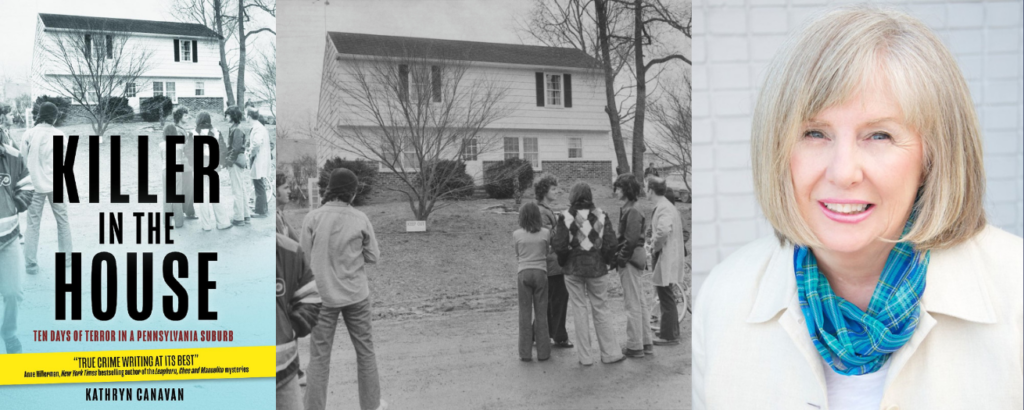
My Q&A with Kathryn Canavan, the author of ‘Killer in The House: 10 Days of Terror in a Pennsylvania Suburb’
I first interviewed journalist and author Kathryn Canavan in 2021 when my Crime Beat column appeared in Philadelphia Weekly.
I interviewed her about her outstanding book, True Crime Philadelphia: From America’s First Bank Robbery To The Real-Life Killers Who Inspired Boardwalk Empire. The true crime book should be of interest to all crime aficionados, especially those living in the Philadelphia area.
Kathryn Canavan now has another true crime book that I read and found most interesting. I reached out to her and asked her why she wrote Killer In The House: 10 Days Of Terror in a Pennsylvania Suburb.
“Three reporters from my first newspaper job showed up at a book signing I did for my last book at a Barnes & Noble in Bucks County,” she explained. “We all started talking about crimes we covered, and they said I should write about the sextuple Abt spree killing because I was the first reporter on the scene and it was the most sensational case in Bucks County in the ’70s. I said, “I don’t write about murders; I write history.” One of them said, “It is history. It’s 47 years ago.” They had me. On my way home I drove to the street where it happened. I parked at the intersection in front of the house. As soon as I saw the house again, I knew I was going to write a book.
“I went home and researched for three days. Then I drove back to Bucks County. On my first day in the neighborhood, I found the patrolman who found the six bodies, a man who helped me on the raucous night of the arrest, and the sole survivor. I thought it was kismet.”
How did your coverage of the murders as a young reporter affect your journalism career?
“My stories about the Abt murders and the killer’s outrageous trial led to a job at a much larger newspaper. I moved to Delaware, but the Abt case was always somewhere in the back of my mind. I always wondered what happened to the people I got to know over the five months between the six murders and the court trial.
How would you describe the Abt family?
“Peggy and Jack Abt both worked and they both commuted to Philadelphia daily, but they found time to do things with their five kids and volunteer in the community. There were allegations that at least one of their sons was using hard drugs.
How would you describe the community where the murders took place?
“Trevose was a woodsy working-class suburb surrounded by caves and hills and the Neshaminy Creek, on the western edge of Bucks County, just two miles from Northeast Philadelphia. It was a neighborhood so safe that middle-schoolers had oversized sleepovers in an empty lot in the summertime.
Why were the Abt family murders so disturbing to the community?
“Neighbors had good reason to believe the murders had something to do with drugs and Clifford Abt, 23. They didn’t.”
I’m not sure if I should ruin the suspense for people who don’t know the case, but how would you describe the mass murderer who slayed the family?
“The killer broke into the Abt house after the last family member left for the day and waited 11 hours to kill them all one-by-one as they came home for the weekend, expecting nothing more than a Friday night fish fry. After each murder, he dragged the body to the basement and then tidied up the kitchen to fool his next victim. He sat at the family piano and waited. He didn’t eat. He didn’t sleep. He didn’t watch television.
“He was a milquetoast 24-year-old who failed at everything he tried. One prospective employer passed him over because she thought he wasn’t assertive enough. After he killed six people he went home and made himself a tuna fish sandwich.”
What was his motivation?
“The killer believed two of the Abt boys were bullying him. Ironically, they were the only two members of the family he didn’t stick around long enough to kill.”
What eventually happened to the murderer?
“He died in prison in 2020. Although it was at the height of Covid, he died of natural causes. He was convicted in 1976, but he didn’t have one visitor at prison until 1979, although he was from a family of six and they lived less than an hour’s drive away. The man who visited him in 1979 was his public defender.”
You also write about the murder of an elderly couple near the Abt family murders. Were the two sets of murders connected?
“The Abt murders were not connected at all to the Vogenberger murders that happened on the same day and during the same hours and just four miles apart. Ralph and Marguerite Vogenberger, both 77, were hit with Taser guns and then shot to death in their gracious Victorian farmhouse just up Brownsville Road from the Abts. Police speculated their killers were using the Tasers to torture them into revealing where on their property they kept thousands of dollars in cash. The couple never gave up their hiding places.”
Was that case ever solved?
“Bensalem Police solved the Abt case in 10 days before the advent of DNA, street cameras, databases, facial recognition, or even cell phones. The Vogenberger murders were never solved. Police tried everything. They even brought in a Delaware psychic who worked for two steak dinners. Her consultation didn’t lead to the murderers, but she did tell police exactly where to look for two metal boxes full of cash. A cold case detective working the murders in the 2020s suspected the same two men as the 1976 detective did — a shirttail cousin of Marguerite Vogenberger and his pal. They escaped from prison together six months earlier. They sent more than 100 items to the FBI for fingerprinting, but not one had a fingerprint from either suspect.
“There was one common thread between the Abt murder scene and the Vogenberger one. Police found a size 9D Sears boot print in the dust in the Vogenbergers’ attic. They found the same boot print in the blood in the Abts’ basement.”
What takeaways do you want your readers to have from the book?
“I guess just the fragility of life. Maria Bryant, who was the Abt’s papergirl, summed it up years later when she told me, ‘It was just an ordinary day, but there was a killer behind the wall.’ People expect things to go bump in the night, but, in 1976, nobody fretted a killer would invade the sanctity of their home in the middle of the afternoon. One woman who was a child in the neighborhood in 1976 is approaching retirement now, but she said she’s still frightened when her family is away and she has to walk into her house alone.
“Every word in the book comes directly from police notes, court transcripts, autopsy reports, IQ tests, school records, prison records, news databases, the killer’s own eidetic confession or interviews I conducted in 1976 or 2022, 2023 or 2024. Re-interviewing people I interviewed in 1976 was like boarding a time machine. I reconnected with the survivor, the detectives, the defense attorney, the patrolman who found the body, and the neighbors. We didn’t know each other well at all in 1976, but we all shared one thing — we were all on Fleetwood Avenue during the 10-day search for the killer, and the slayings shook us all back when multiple murders still jolted people.”
Killer In The House is a fascinating, well-written and well-researched true crime book.
Paul Davis’s Crime Beat column appears here each week. He is also a contributor to Broad + Liberty and Counterterrorism magazine. He can be reached via pauldavisoncrime.com.