White House accepts reality in dealing with House of Saud
In November 1979, then Georgetown Professor and registered Democrat Jeane Kirkpatrick penned a pivotal essay entitled “Dictatorships and Double Standards” for Commentary magazine. Unnerved by the Carter administration’s flat-footedness amidst growing crises in Nicaragua and Iran, Kirkpatrick wrote, “The foreign policy of the Carter administration fails not for lack of good intentions but for lack of realism about the nature of traditional versus revolutionary autocracies and the relation of each to the American national interest.”
In other words, Kirkpatrick argued that while the previous autocratic governments of Iran and Nicaragua were far from perfect, they provided at least a modicum of stability in their respective regions. The same could not be said now that the Ayatollah and Sandinistas had taken power in their respective countries. For Kirkpatrick, a U.S.-aligned autocracy was a preferable alternative to anarchy or, even worse, a revolutionary government bent on exporting its ideology to other vulnerable nations. When Kirkpatrick became the U.S. Ambassador to the United Nations in 1981 during the Reagan administration, the thesis of her Commentary essay became known as the “Kirkpatrick Doctrine.” While Kirkpatrick and her guiding philosophy were sometimes flatly wrong (such as cozying up to the Argentines during the Falklands crisis), her point about pursuing stability over lofty idealism is something that needs to be considered when dealing with American geostrategic interests.
Such is the more contemporary case with Saudi Arabia. Ever since President Roosevelt’s 1945 meeting with the King of Saudi Arabia, Abdul Aziz al-Saud, the United States has had a very unique relationship with the House of Saud. In decades past, flareups in the relationship periodically occurred such as when the Saudis and other Gulf Arab states embargoed oil shipments to the United States in the 1970s. Or more recently, Americans became outraged at Riyadh when it became clear that fifteen of the nineteen hijackers on September 11 held Saudi passports. Additional, and more perennial, concerns surrounding Saudi Arabia pertain to the Kingdom’s treatment of women and its harsh Sharia-based judicial system.
But perhaps the most searing rift in recent years occurred in 2018 with the killing of Saudi journalist Jamal Khashoggi. Lured into the Saudi consulate in Istanbul, Khashoggi was brutally killed and dismembered by Saudi intelligence operatives. The Crown Prince Mohammed bin Salman (Saudi Arabia’s de facto ruler who often goes by the acronym MBS) is alleged to have ordered the killing as a means of silencing Khashoggi’s criticism of the Saudi monarchy.
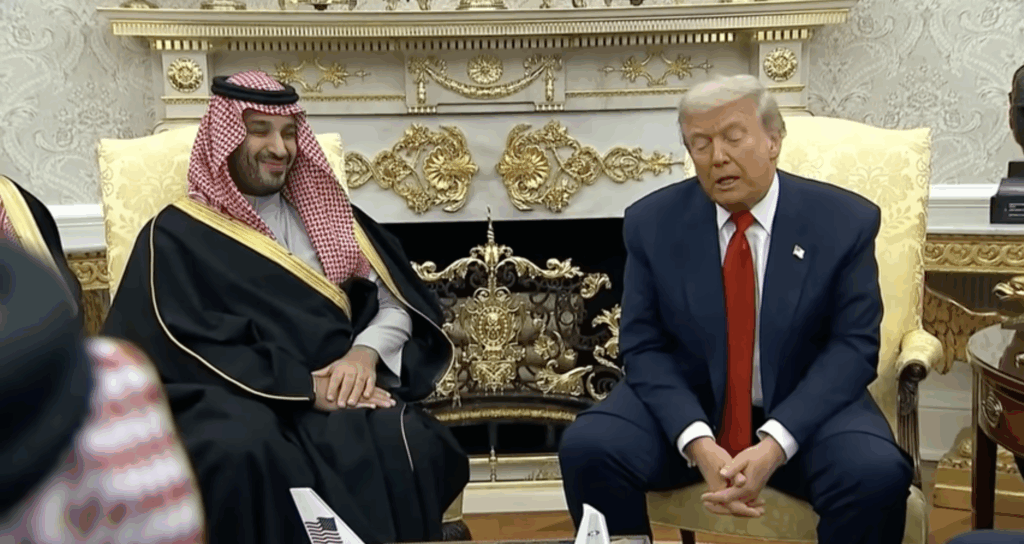
The Khashoggi scandal and MBS’ involvement resurfaced this week at the White House. The Saudi Crown prince traveled to Pennsylvania Avenue to meet with President Donald Trump on issues ranging from Israel to civil nuclear cooperation. Reporters present questioned MBS and Trump on the Khashoggi killing with MBS calling it “painful” and the president going as far to say, “Things happened, but he [MBS] knew nothing about it, and we can leave it at that.”
Those who wish to focus on this particular exchange run the risk of missing the forest for the trees. As part of the larger meeting, MBS and Saudi officials expressed continued interest in joining the Abraham Accords so long as their was a “clear path [toward] a two-state solution.” Note here that MBS is not calling for an immediate and hasty recognition of a “Palestinian state” similar to what France and the U.K. did two months ago. He merely is asking for a vague conversation or flimsy agreement of what that state may look like. Rather tellingly, a key Gulf Arab leader is not demanding either the destruction of Israel nor the immediate establishment of a Palestinian state. Rather, MBS views coexistence with the Israelis as a key geostrategic goal that in some ways supersedes continued grandstanding over Palestinian statehood.
Additionally, MBS affirmed that the United States was the Kingdom’s “primary strategic partner” on the world stage. In exchange, the United States affirmed Saudi Arabia’s status as a non-NATO major ally and pledged future deliveries of F-35 fighter jets to Riyadh. MBS continued with a pledge of $1 trillion worth of investment in the United States. In short, the two parties present at the White House this week continued to outdo each other in terms of their mutual loud agreements concerning the Saudi-American relationship.
Now some throat clearing is in order. Khashoggi’s murder was abominable, and the Saudi state is a long way from becoming a human-rights paragon. On the flip side of the coin, some of the Trump family’s ties to Saudi businesses rightfully should raise eyebrows. But if supporting the monarchy of MBS leads to a more modernized Kingdom of Saudi Arabia (see Riyadh’s “Vision 2030” plan) that has leaned away from its Salafist/Wahhabist religious fanaticism and rabid anti-Israelism, isn’t there reason to believe that this is the best option available? Rarely in foreign policy are we given the pure idealist path that leads to an idealistic outcome. Often, bargaining needs to be done in order to ensure stability. In essence, it is often better to deal with the devil that you know rather than the one that you don’t.
The Kirkpatrick Doctrine (like any foreign policy theory) should not be taken as gospel. However, look at the two examples she outlined in 1979 and see where they are at now. Nicaragua is currently under the dictatorship of the preeminent Sandinista, Daniel Ortega, whose government is currently “one of the most repressive states in Latin America” according to The New York Times. Iran since 1979 has become a brutally oppressive theocracy that incarcerates women for violating “modesty” laws. Kirkpatrick’s theory raises the question, could the fates of both of these countries have been better if the American-friendly autocracies weathered their respective storms?
MBS is not a squeaky clean leader and Saudi Arabia isn’t on most people’s shortlist of spring break destinations. But in dealing with reality, the Kingdom is still a strategic ally in the long term. Were MBS to be overthrown tomorrow, what or who would come in his place? Are Riyadh’s domestic and international advancements over the past seven years rendered null and void because of the October 2018 events at the Istanbul consulate? Perhaps most importantly, two things can be true at once: MBS can be cold-blooded, but he could also be the only broker in the Kingdom that the U.S. can have any hopes of dealing with.
Jim Pomeroy, raised in Bucks County and a former congressional aide, works in higher education. He is the author of Alliances & Armor: Communist Diplomacy and Armored Warfare during the War in Vietnam.