Understanding NYC’s banner battle
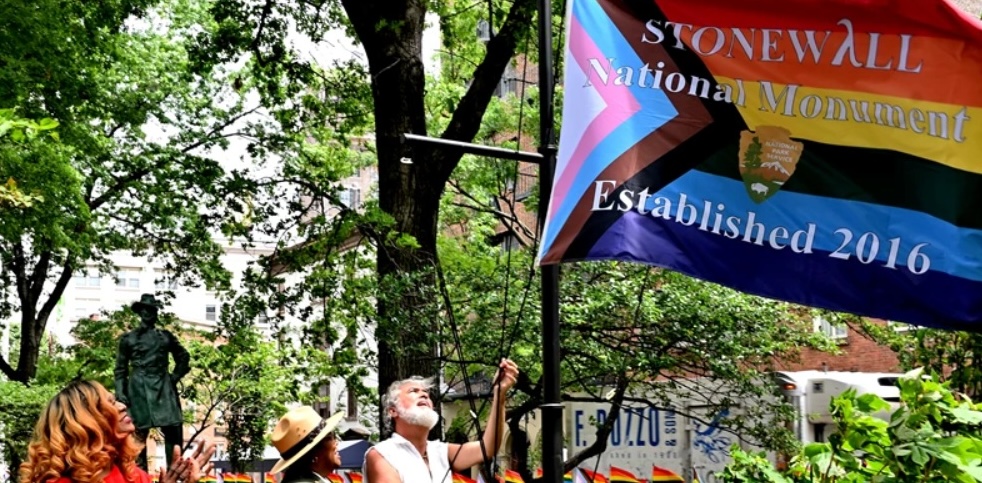
Sometime between late night on February 8, 2026 and early the following morning, federal authorities removed the pride flag that was flying on the property of the Stonewall National Monument. The Monument commemorates the Stonewall riots which started early in the morning on June 28, 1969 and lasted until July 3 that year. The riots were in response to years of frequent police raids at the Stonewall Inn, which was a Greenwich Village bar popular with sexual minorities.
The removing of the flag has sparked protests in the days that followed, and a considerable amount of criticism of the Trump administration from elected officials, activists, political commentators, and everyday citizens.
On February 12, 2026, New York City officials and activists brought another pride flag with them to the site, and attached it to the U.S. flag, albeit slightly higher — which is a violation of official flag code. Numerous people have insisted that the pride flag is a representation of LGBTQ+ humanity and not a political symbol.
A 2023 General Services Administration (GSA) policy states, “Flagpoles at buildings under the jurisdiction, custody or control of GSA are not intended to serve as a forum for free expression by the public. Rather, approved flags (other than the Flag) and pennants may be flown as an expression of the Federal Government’s official sentiments.”
The Trump administration’s “One Flag Policy” is based on a January 2026 memo from the Department of the Interior which oversees the National Park Service. That memo was written to supplement the GSA policy. The memo also closely aligns with the One Flag for All Act (H.R. 1313), a bill currently in Congress.
Despite criticisms and claims of “targeting” and “erasure,” other flags that would also be prohibited on Park Service flagpoles would include Back the Blue, the Confederate flag, the National Rifle Association banner, as well as other social and political movement flags. Exemptions to the policy include state and local government, POW/MIA, and national observances. Cemeteries are also exempt.
It should be noted that the pride flag will still be on display in the Stonewall National Monument Visitor Center. The center is not managed by the Park Service, but rather an independent nonprofit funded by donors and community partnerships.
The origins of the pride flag go back to 1978. Harvey Milk, one of the first openly gay politicians to be elected to public office, approached an artist friend of his named Gilbert Baker to design a symbol to represent the gay community. Milk was a member of San Francisco’s Board of Supervisors, and he was looking for a symbol to use at the San Francisco Gay Freedom Day Parade that year. The pride flag began as a socio-political symbol requested by a politician, and intended for a specific event.
Skipping ahead to 2017, the City of Philadelphia Office of LGBT Affairs released the Philadelphia Pride Flag, which added black and brown stripes to the rainbow pride flag in a politically motivated response to a history of discrimination against Black and Brown people in White LGBTQ+ spaces.
Politically motivated modifications occurred in 2018, when artist Daniel Quasar designed the Progress Pride flag which incorporated pink, white, and blue stripes in reference to the Trans Pride flag. Then in 2021, Valentino Vecchietti designed an intersex-inclusive Pride flag, which includes a purple circle over a yellow triangle.
In 2023, Philadelphia Flyers defenseman Ivan Provorov refused to practice with the team on Pride Night because he did not want to wear the Pride flag colors. The criticism and backlash he received in the traditional and social media speak to the solvency of the political currency held by the Pride flag.
Many symbols have multiple layers of meaning. Different individuals will focus on different elements within those layers. Regardless of how people feel about the pride flag, there is no escaping the symbol’s political origins and continued political messaging.
A flag has no intrinsic power. A flag cannot make one strong, beautiful, or excellent. Those are qualities that come from inside a person. I think that the Pride flag puts too much focus on a person’s sexual orientation or gender identity at the expense of other, more vital aspects of their humanity. People are better served, and more completely supported, by others who lean into and support their individuality rather than treating them as a bloc.
Milo Morris is a Bucks County resident, opera singer, and chairman of the Black2Red PAC.