Is Fitzpatrick campaign involved in “meddling ads”?
Over the past few election cycles, we have seen political parties try out a new strategy – spending money on ads that help extreme members of the opposing party win that party’s primaries.
The strategy behind this is simple: if you help an extreme candidate on the other side win their primary, you might increase your own chances in the general election. That is because it is generally easier to beat an extreme candidate than a moderate one in a general election.
It appears that this is happening in 2026 in Pennsylvania’s 1st Congressional District. And the Brian Fitzpatrick For All campaign seems to be all in on the strategy.
Recently, mailers have been appearing in the mailboxes of high-propensity Democratic voters against PA-01 Democratic candidate Bob Harvie. The mailers are paid for by the Republican Federal Committee of Pennsylvania with an address of 115 State Street in Harrisburg. The organization’s treasurer is Sam Demarco, former chair of the Allegheny County GOP and now the southwestern PA regional director for Sen. Dave McCormick.


On two different dates, the Fitzpatrick For All of Us organization made disbursements to the Republican Federal Committee – once on Feb. 13 for $180,000, and another on March 6 for $170,000. That adds up to $350,000.
Other connected committees to the Republican Federal Committee of Pennsylvania include Team Fitz (which is connected to Brian Fitzpatrick For All of Us), Smucker Victory Committee, Team Perry Victory, Team GT, Team McCormick, and Team Rob, to name a few.
In addition, Facebook users in the district have been treated to video adsfrom “Fire Bob Harvie.” They are sponsored posts to the tune of $8,508from Brian Fitzpatrick for All of Us and began running on April 6. Two different versions of the ad have been seen on a screen between 600K and 700K times, including multiple views by the same people.
Harvie, chair of the Bucks County Commissioners, is one of two candidates, along with scientist Lucia Simonelli, running for the Democratic nomination on May 19 in hopes of being able to challenge Fitzpatrick in the fall.
Fitzpatrick is a five-term congressman who has won his last two elections by double digits. His closest reelection contest was in 2018, when he defeated Scott Wallace by 2.5 percentage points.
So what gives? Is this a sign that Fitzpatrick might not want to face Harvie?
Not necessarily.
“Our campaign against FBI Corruption Subject Bob Harvie is currently being messaged to select targeted voters in ALL parties, to include Republicans, Democrats and Independents (NOT just Democrats), and this will continue until he is removed from office,” said Fitzpatrick campaign spokesperson Heather Roberts in an email to PoliticsPA.
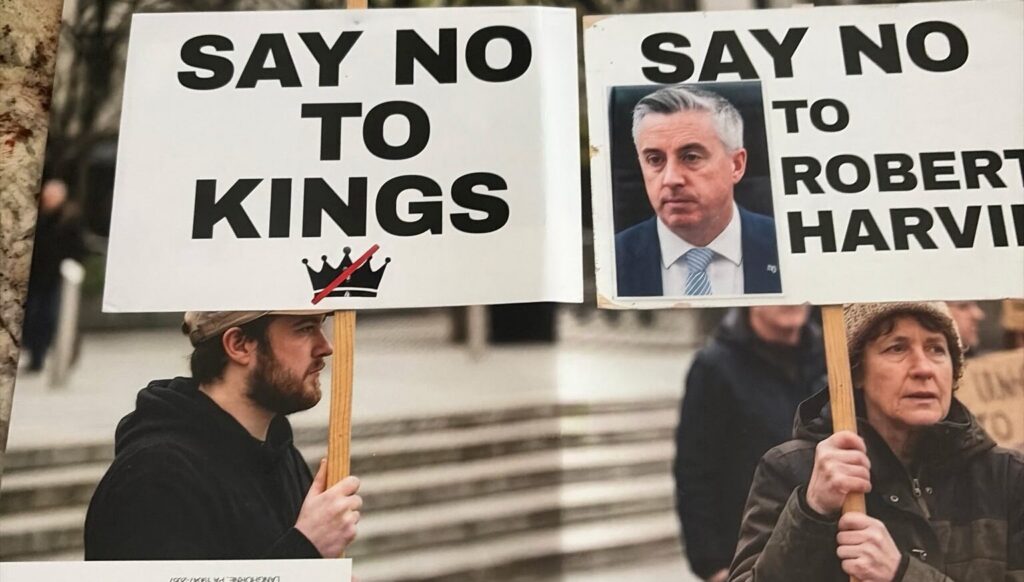
“We are exposing that he voted himself a pay raise while simultaneously and repeatedly raising taxes on struggling working families, the FBI investigation into his corruption, his King-like arrogance, his misappropriation of county tax dollars, and his illegal efforts to overturn the 2024 election, where the Washington Post Editorial Board called him “Corrosive to Democracy.” After 25 years of documented political corruption, it is long past time to Fire Bob Harvie.”
Another question to ask might be, is this a good idea? Do these type of mailers and ads have the desired impact and effect?
Professor Mohamed Hussein of the Columbia Business School refers to this practice as “meddle ads” and says that often times, the strategy backfires.
“Our research looked into how people react when they find out a candidate from their own party used meddle ads,” he wrote in 2024. “Across studies with over 7,000 respondents, we found that people are overwhelmingly averse to the use of meddle ads. When they learn that a candidate used meddle ads, they tend to speak negatively about that candidate, report more negative opinions, donate less to the campaign, and are less likely to vote for them in hypothetical elections.
“It didn’t matter if we compared candidates using meddle ads to those whose strategy was unknown or to those using traditional ads focused on issues like the economy or abortion. People consistently reacted negatively to meddle ads and penalized the candidates who used them.”
However, such “meddling” can be effective and even successful.
“They could work. A primary race is one of the places where persuasive political advertising is likely to have an impact,” says Travis Ridout, a professor of government at Washington State University and co-director of the Wesleyan Media Project, which tracks political advertising.
Pennsylvania saw an example of this during the 2022 gubernatorial campaign when Josh Shapiro and the Pennsylvania Democratic Party financed ads on television and via mailers that played up the connection between state Sen. Doug Mastriano and then-former President Donald Trump.
The ads warned that Mastriano wanted to ban abortion, “lead the fight to audit the 2020 election” and was closely aligned with Trump. “If Mastriano wins, it’s a win for what Donald Trump stands for. Is that what we want in Pennsylvania?” stated one ad.
Shapiro spent approximately $840,000 in the Republican primary to call Mastriano “one of Donald Trump’s strongest supporters.” Despite having a 14-point lead over the field, the spending may have helped the Adams/Fulton County senator to a 24-point win.
“For weeks, both public and private polling indicated that Doug Mastriano was poised to win the Republican primary — and our campaign was prepared to start making sure Pennsylvanians knew his real record early,” Manuel Bonder, a spokesperson for the governor, said at the time. “Mastriano’s entire campaign was focused on banning abortion with no exceptions, restricting the right to vote, and overturning the 2020 election just to appease Donald Trump — and we didn’t allow him to paper over those facts, even for a second.”
In a general election, party affiliation is a cue that influences the choice of many voters. In a primary, without the Red vs. Blue choice, indications of ideology or placement in a party’s political spectrum can make a difference, Professor Ridout says.
And in a primary, voters’ knowledge of candidates and their policies is pretty low. Basics such as name recognition are important. Ads that blast out an opponent’s name could change the nature of the race.
“There’s a rule in politics: You’re not going to vote for someone you’ve never heard of before,” says Professor Ridout.
Steve Ulrich is the managing editor of PoliticsPA where this article originally appeared.