Iran Round Two?
There is an oft-quoted exchange from the NBC show 30 Rock in which main character Liz Lemon (Tina Fey) remarks to her swaggering, no-nonsense boss Jack Donaghy (Alec Baldwin), “What a week, huh?” Donaghy abruptly turns to Liz and says “Lemon, it’s Wednesday.” Looking back on the foreign policy earthquakes of the past two months, I’m tempted to say, “What a year, huh?” only to be met with the obvious rejoinder of “Pomeroy, it’s February.”
To recap, there was a Delta Force operation in Caracas to capture Nicolás Maduro. Happening alongside the raid was a horrifying crackdown on Iranian protestors in the streets of Tehran and dozens of other Iranian cities. There was the first summit meeting of President Donald Trump’s “Board of Peace.” British, French, and U.S. aircraft bombed ISIS targets in Syria as the ruling government in Damascus launched military operations against the Kurds. The Trump administration then played needless hardball with the Danes over Greenland all while major wars still raged in Ukraine, Sudan, and Myanmar. At the risk of turning this article into a lyrics page of some 2026 version of “We Didn’t Start the Fire,” I will leave the summation there.
As February comes to a close, it seems that the tempo of international tensions refuses to slow down. In mid-January, protests were still raging in Iran when Trump declared “help is on its way” in a clear message to anti-regime activists. The protests continued and as many as 30,000 Iranians died by the end of January as a result. While the Trump administration took no immediate kinetic action against the Iranian regime, a carrier strike group consisting of the USS Abraham Lincoln and three Arleigh-Burke class destroyers was sent to the Persian Gulf at the end of last month. Soon thereafter, the administration began to negotiate with Iranian government officials over Tehran’s ballistic missile and nuclear capabilities. When those talks hosted in Geneva stalled a week ago, Trump then ordered the USS Gerald Ford and its carrier strike group to join the USS Abraham Lincoln already on station.
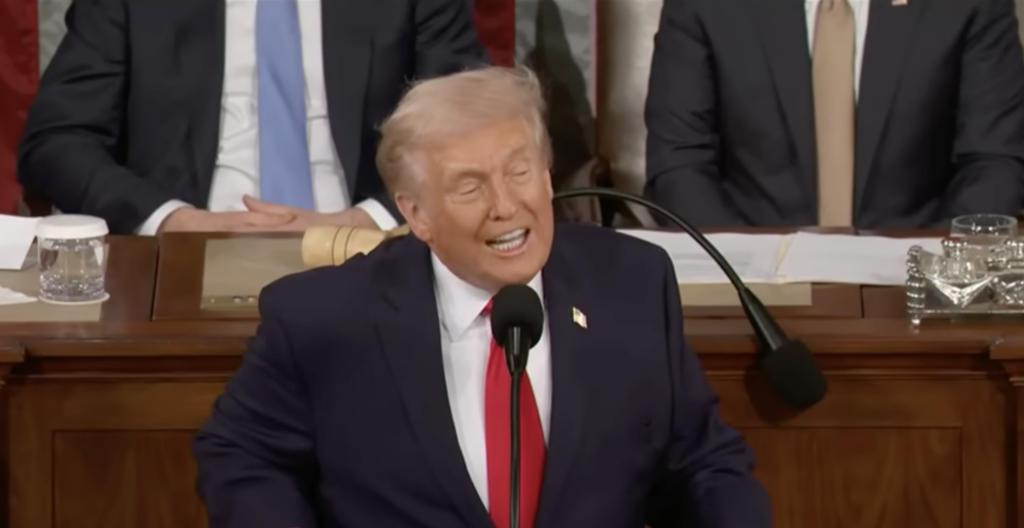
Talks in Geneva seem to be stuck in limbo at this writing. Following Trump’s State of the Union speech, Iranian officials denounced the White House’s accusations of a renewed nuclear weapons program and increased persecution of Iranian dissidents as “big lies.” Continued talks are set to resume this week, but there is uncertainty (to say the least) about what comes next if this round of negotiations yields nothing.
The administration is being less than forthcoming about its policy vis-à-vis Iran. For starters, let’s go back to Trump’s promise of “help is on the way” to the Iranian protesters. As far as I can tell, that “help” never arrived. To be fair to Trump, presidents throughout U.S. history have signaled their willingness to intervene in another country’s civil strife only to back down when said strife exploded. Eisenhower in 1956 did not intervene in Hungary despite Radio Free Europe’s encouragement of the Hungarian people’s protests. In 1991, George H.W. Bush did not intervene during Saddam Hussein’s brutal suppression of Iraq’s Shia and Kurdish populations immediately following the Gulf War despite previously urging the Iraqi people to “force Saddam Hussein, the dictator, to step aside.” Perhaps the most recent, and infamous, instance came when Barack Obama declared a “red line” regarding chemical weapons use in the Syrian Civil War. When that red line was indeed crossed in August of 2013 by the Assad regime, the Obama administration did not take action and instead engaged in — you guessed it — negotiations.
This past January, Trump repeated the same sort of red-line ultimatum regarding Tehran’s slaughter of protesters. When the killings continued, Trump demurred and instead pursued negotiations over nuclear capabilities. To be clear, I do not believe that the United States should have any “responsibility to protect” doctrine. But if you are going to draw a line in the sand, you have to realize that you may be called upon to back it up. Recent reporting shows that a new wave a of protests has begun to spread in Iran. Perhaps the appearance of two U.S. aircraft carriers will discourage the Iranian regime from brutally suppressing these protests. But if the regime pursues its usual doctrine of suppression, is the administration going to back up its tough talk?
On the flip side is Trump’s renewed fixation on Iran’s nuclear and ballistic missile programs. Back in June 2025, the U.S. in conjunction with Israel bombed several sites in Iran associated with uranium enrichment. The aftermath of what was dubbed “Operation Midnight Hammer” was met with football spiking declarations of total victory emanating from the White House and the Pentagon. However, if Trump’s recent accusations are true and Iran is back to uranium enrichment in recently repaired or newly constructed facilities, then wasn’t Midnight Hammer ultimately a failure? During his first term, Trump was right to call the Obama-era Joint Comprehensive Plan of Action (JCPOA) a feckless agreement. This was especially true given the fact that the deal was pressed through as the Iranians increased their oppressive influence both at home and abroad. Currently, the Iranian regime’s ability to flex its muscles abroad have been atrophied to a breaking point. However, as was evidenced last month, its ability to brutalize and massacre its own populace remains as strong as ever. Is the administration going to walk back its previous “help is on the way” promise so long as a “deal” is made? How would such a deal differ from the JCPOA? All of this remains to be seen or articulated.
The confusion behind the current Iran showdown is worsening by the day. Rarely does the United States send not one but two carrier strike groups into a region unless the president intends to use them. If this is indeed a symbolic flex, then it is an awfully expensive one. If by some miracle a nuclear deal is reached, will it give implicit permission for Tehran to once again start gunning down its dissidents in the streets? Inversely, if the administration does take a “responsibility to protect” approach reminiscent of Bosnia in 1995, how long will that campaign last? These two competing objectives (stopping Iranian domestic oppression versus stopping a renewed nuclear program) are clouding each other out. The administration has not outlined any goals regarding the current force posture in the Persian Gulf. Normally gunboat diplomacy has a clearly defined “do X or else.” Perhaps the administration wants to clean up the remnants left after Midnight Hammer. Perhaps Trump wants to overthrow the regime in Tehran. Or maybe he wants both. Meanwhile our assets in the region have been on prolonged standby. In fairness, that is a huge part of the U.S. Navy’s global posture. But a global posture requires a global presence. The deployment of both the Gerald Ford and the Abraham Lincoln in one specific region limits our navy’s coverage elsewhere (namely the Luzon and Taiwan straits).
Maybe this is Trump’s version of the hardly uncommon lame duck presidency military deployment (think Eisenhower’s Lebanon action in 1958 or George H.W. Bush’s deployment into Somalia in 1992). Even if that’s true, he has plenty on his plate already, including Venezuela, Gaza, and Ukraine. Is another commitment abroad really advantageous to his accruing list of foreign policy initiatives? At this point, it seems like the die has been cast and the list is going to expand to Iran. Thus, we are again forced to wince and wait for something to happen without any idea of what or why. To quote a famous quip from another beloved piece of American media: “I picked the wrong week to quit sniffing glue.”
Jim Pomeroy, raised in Bucks County and a former congressional aide, works in higher education. He is the author of Alliances & Armor: Communist Diplomacy and Armored Warfare during the War in Vietnam.