When ‘fairness’ means erasing women
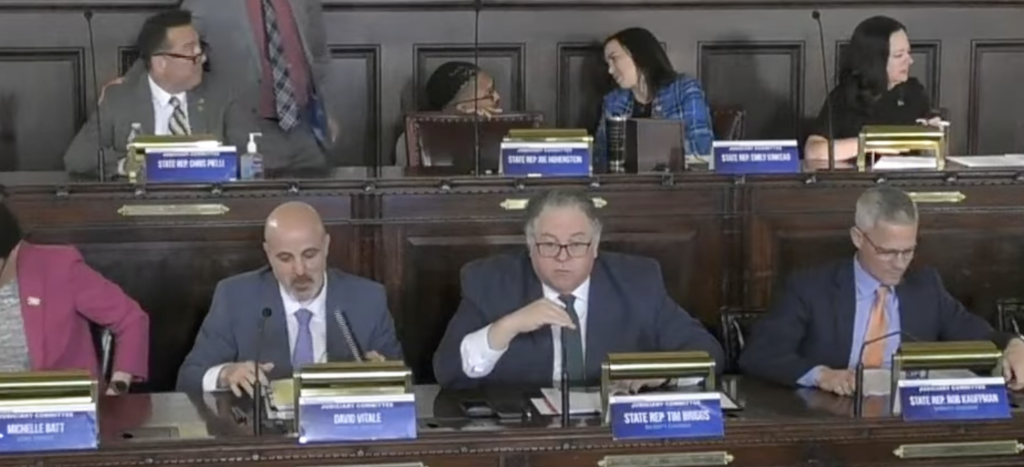
The latest meeting of the Pennsylvania House Judiciary Committee should be a wake-up call for women across this commonwealth.
In vote after vote, Democrats advanced legislation that benefits one special class above everyone else — trans-identifying males — while expecting women to accept the consequences in silence. This is the same political party that claims to stand for women, yet in practice is advancing policies that erase women’s rights, undermine their safety, and then attempt to gaslight us into believing it’s about “fairness,” “tolerance,” and “love.”
At the center of this push is House Bill 300, the so-called “Fairness Act.” The name is misleading. There is nothing fair about a law that opens women’s spaces to males.
HB 300 adds “gender identity” to Pennsylvania’s nondiscrimination law without providing any clear definition for “gender identity.” That’s not an oversight. This lack of clarity is the mechanism that allows this policy to be stretched to its extreme outcomes. In states that have already gone down this road, the results are clear: males competing in women’s sports, entering women’s locker rooms and bathrooms, and gaining access to private spaces that were created specifically to protect women.
Let’s be clear about what that means. This is not hypothetical. This is not fear-based. This is already happening across the country and Pennsylvania Family Council has documented many of these cases on our website.
Women’s shelters — places designed to protect victims of abuse, many of whom are fleeing traumatic experiences involving men — are being forced to admit males based solely on self-identification. That is not compassion. That is a policy failure that places vulnerable women at even greater risk.
Women’s sports, hard-fought and hard-won through decades of advocacy, are being dismantled. Female athletes are being forced to compete against males with biologically inherent physical advantages, costing them opportunities, scholarships, and fairness.
Private spaces — bathrooms, locker rooms, dorms — are no longer private. HB 300 would prioritize self-defined identity and mere “expression” claims over biological reality.
This is not a far-fetched concern. In Washington state, a Korean women-only spa became the center of national headlines after a male was allowed to enter the female facility, where women are nude, under that state’s gender identity law, sparking protests from women who objected. As one judge later warned in the case, the policy effectively allows “a person with male anatomy… to enter areas where women are fully nude,” regardless of the concerns of those women. And this is not an isolated incident — similar controversies have emerged across the country, including a 2021 case at a Los Angeles spa where a male exposing himself in the women’s section was later identified as a registered sex offender, as well as a lawsuit in New Jersey over access to a women’s spa.
Under laws like those proposed in Pennsylvania, women who peacefully protest such policies could themselves face punishment under expanded hate crime statutes. And when combined with bills like HB 1315, which would allow sealed name changes for gender identity (a practice currently reserved for victims of domestic violence), it becomes even easier for bad actors to exploit the system — whether entering private women’s spaces or even seeking positions of trust around children.
Women are expected to simply accept this? And if we don’t?
House Bills 1902 and 1905 seek to amend Pennsylvania’s Ethnic Intimidation statute to include “gender identity,” again, with no definition. While framed as protections against harassment, these bills create a real and dangerous risk: that women who speak out, who object, or who simply state biological reality would face consequences.
A woman who questions why a trans-identifying male is in her locker room could now be treated not as someone raising a legitimate concern, but as someone engaging in the moral equivalent of physical intimidation.
Taken together, these bills represent a sweeping ideological shift in Pennsylvania law; one that elevates subjective self-expression or identity over objective biological reality, and in doing so, places the burden squarely on women.
Women are being told to step aside in their own sports. To stay silent in their own spaces. To accept discomfort, risk, and expose themselves to males in the name of someone else’s identity.
And if they push back, women are told they are the problem. That is not equality. That is not fairness. That is not tolerance.
It is the reordering of rights in a way that demands women lose so that others can gain. Pennsylvanians should be asking a simple question: When did protecting women become controversial?
There is nothing extreme about acknowledging biological reality. There is nothing hateful about protecting women’s spaces. There is nothing unjust about ensuring that laws designed to protect women continue to do so.
If these policies are codified into law, the consequences will not be theoretical. They will be lived by women and girls across Pennsylvania. This moment demands clarity, not confusion. Courage, not compliance. And above all, it demands that we tell the truth, even when those in power would prefer that we stay silent.
Emily Kreps serves as the director of legal operations with the Pennsylvania Family Council. Go to pafamily.orgto learn more.