McCormick and Bhattacharya tout medical advances in visit to Penn Medicine
“These are the days of miracle and wonder” — Paul Simon
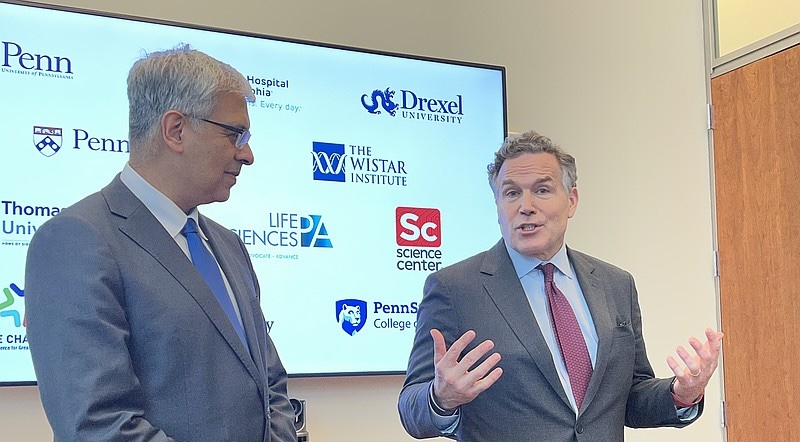
Sen. Dave McCormick (R-Pa.) and National Institutes of Health (NIH) Director Dr. Jay Bhattacharya toured the Perelman Center for Advanced Medicine at Penn Medicine at the University of Pennsylvania, highlighting some of the major medical breakthroughs from Penn scientists’ research.
“Pennsylvania is one of the leading states for life sciences,” said McCormick, at a press conference following the March 31 tour. “It’s a big NIH recipient of about $2.2 billion a year. “This creates 21,000 direct jobs, almost 100,000 indirect jobs, in terms of the commercialization of the technology.”
Penn Medicine is where “discoveries that change people’s lives and increase longevity,” he said.
“It’s also critical, this area of life sciences, where we’re in a competition, really, with China for leadership,” said McCormick.
There are “huge national security implications. This is a driver of innovation, and job growth and opportunity in our great commonwealth for our young people.”
In southeastern Pennsylvania, healthcare, education, and the pharmaceutical industry — the so-called “eds and meds” — comprise a sizable piece of the economic pie.
Most residents work in educational services, followed by healthcare and social assistance, according to the Delaware Valley Regional Planning Commission. These areas account for 64.5 percent of the region’s basic jobs.
McCormick and Bhattacharya also toured research facilities in Pittsburgh on Monday. There, they visited a vision center that is “bringing people back from blindness with AI.”
“The pace of change is enormous,” said McCormick. “It’s going to change the future of America, the future of humanity. And Pennsylvania is uniquely positioned to play this enormous leadership role.”
Bhattacharya said Pennsylvania-based research will have nationwide impacts, including helping stroke victims regain their ability to walk and restoring vision to some patients.
“Here we met patients given a second lease on life from deadly cancer,” said Bhattacharya. “To me, that’s what the NIH is all about: taking the investment of the American taxpayers, putting it in places like Penn, like UPMC, and turning that into better lives and health.”
Broad + Liberty asked them what the most surprising research they’d seen at Penn Medicine was.
“The CAR-T labs,” said McCormick. “It’s remarkable. It’s essentially an invention that was brought about here to be able to take cancer cells, take them out of the body, and essentially make them fighters.”
Those cells are then returned to the patient’s body and begin to fight cancer, “primarily blood cancers.”
“To bring people back from the brink of death, and we are at the point now where it’s hitting the hockey stick of scalability,” said McCormick. He noted that Penn researcher Dr. Carl Jung worked on this “breakthrough discovery that is literally changing our ability to deal with cancer” for 20 years. It may also treat other cancers and other diseases, he said.
“You invest in one area, and all of a sudden you get an advance in another area,” said Bhattacharya. “The CAR-T advance originated in an investment in treating HIV research in reprogramming immune cells.”
Bhattacharya highlighted Baby KJ, a patient at Penn, who was born with a liver problem where toxins accumulated in the liver. The baby was treated with gene-editing therapy developed at Penn. The NIH has funded the gene-editing technology for decades, he said.
“It enabled Baby KJ to live a full, long, healthy life. It’s absolutely inspiring.”
But while praising Penn Medicine, Bhattacharya said he’d like to spread the wealth.
He hopes to see NIH money seed research around the country, “not just places like Philadelphia and Boston.”
“The problem is that 20 institutions get about a third of our external money,” said Bhattacharya. “It’s often considered seed money. When NIH invests in an institution, you often get private donors also invest, the institution itself invests, philanthropic organizations invest…We need to broaden the base of where we send NIH money.”
Throughout the U.S., “what I found there is a huge number of amazing people with great ideas. All that’s needed is just a little bit of investment, and you can just unleash and continue the biomedical revolution.
“If we do that, I’m not worried about the competition with China,” Bhattacharya added. “Because in the United States, the amount of ingenuity, the amount of knowledge, the amount of real freedom to explore ideas wherever they may be with the purpose of advancing, helping people, I just see that everywhere.”
McCormick said AI is changing the pace of research science. During his panel discussion with the researchers, “the question we landed on was the incredible opportunity this creates for young people to make a difference, to embrace this moment of change and do so in Pennsylvania, because we’re blessed with all of the fundamental ingredients of this life sciences revolution,” McCormick said.
The NIH’s mission is to prolong lives and make people healthier, but in the last fifteen years, “we’ve seen the flatlining of life expectancy,” said Bhattacharya.
We need to “translate into real, affordable treatments” for conditions Americans face, he said. “And then we will see life spans going back up.”
Another reporter said that Philadelphia has been affected by NIH funding “cuts” and “delays in getting grants approved due to government shutdowns.”
“There were no cuts last year,” said Bhattacharya. The NIH spent all $48 billion that Congress allocated. This year, its budget rose one percent.
‘What did happen was a refocusing of where we made those investments,” Bhattacharya said. “The idea was to take politics out of the portfolio. Some were politically divisive and didn’t really translate into better health for people.”
And the NIH staff “worked like crazy” to “get the money out” after the government shutdown ended last year.
“If you’ve been awarded a grant, you’re going to get that,” said McCormick, adding that it was unlikely that NIH funding would decline. McCormick said he would oppose NIH cuts, which have a “huge impact” in Pennsylvania.
Asked about fewer new NIH grants from this administration, Bhattacharya agreed that there were fewer grants but said those grants were larger.
He’s seen how hard it is for younger researchers to get their first grant, and he’d like to make sure people in their 30s get grants earlier in their careers because they often have the newest ideas.
“A fundamental problem is we punish failure too much,” he said, in contrast to Silicon Valley. “We need to find ways to give researchers a second chance in medicine.”
The University of Pennsylvania received $723 million in FY2025. Penn researchers used the funding to study cancer, neuroscience, cardiovascular disease, aging, population health, health services research, genomics, gene and cell therapy, and bioengineering.
“Like Penn’s tightly integrated campus, what sets Philadelphia’s eds and meds apart is our critical mass of expertise and pioneering research – all nearby, in sync, and of service to all Pennsylvanians,” said Penn President J. Larry Jameson.
Linda Stein is a Philadelphia area journalist.