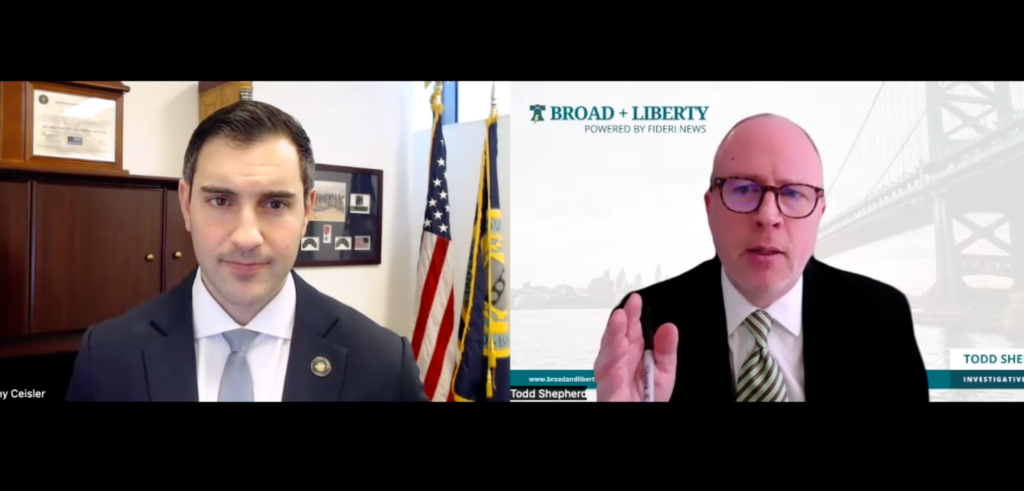
Bucks Co. Sheriff explains ending 287(g) ICE Agreement: Full interview with Danny Ceisler
When newly elected Bucks County Sheriff Danny Ceisler announced he was ending an agreement for “task force” policing with U.S. Immigration and Customs Enforcement last month, he knew the announcement would be controversial. Although controversy certainly did follow, he also says he realized how media headlines were still leaving citizens in the dark about what he believes really happened with the policy shift.
Ceisler, a Democrat, says with the termination of the 287(g) agreement that his predecessor had initiated only nine months before that his office was not setting a new standard in its cooperation with ICE. Instead, he says, the office went back to the same standards it had employed for years — including under previous Republican administrations.
Ceisler talked about many of his philosophical beliefs that informed his decision, all while adding nuts-and-bolts clarity to many of the nuances of how local sheriff’s offices interface with ICE. He also made a bold statement about immigration, generally, by saying the U.S. needs to create an “impenetrable” northern and southern border.
Todd Shepherd, Broad + Liberty: Hi everyone, welcome in. I’m Todd Shepherd, chief investigative reporter for Broad + Liberty, part of the Fideri News Network. And for those of you who don’t know Fideri News Network, we own about eighteen different news properties from southeast Pennsylvania all the way to the Jersey Shore. So even though I’m the chief investigative reporter for Broad + Liberty, you may be seeing this video on some other sites — say, for example, The Bucks Independence, which is another one of those news properties that we own and operate. We’re very excited today to do this special video report. We don’t always do this kind of reporting, but very glad today to have the chance to go in depth on… I think it’s fair to say if you were to pick one news topic that’s dominated since the beginning of the new year, that would be Immigration and Customs Enforcement, not just nationally, but locally as well.
And so that’s why we’re really happy today to have our special guest. We welcome in Sheriff Danny Ceisler. He’s the sheriff of Bucks County, and he’s very new at the job. He’s been sworn in less than six weeks. So let’s just start by saying Sheriff Ceisler, thanks so much for being willing to take some time and talk to us here today.
Bucks County Sheriff Danny Ceisler: Absolutely. And Todd, thank you so much for the opportunity to speak with your audience today. I appreciate it.
B+L: Yeah, you bet. So I think the appropriate place to start is we’re going to be reaching an audience outside of Bucks County. So for those people who might have lived in Montgomery County or Berks or even Adams, give us the 60-second background of Danny Ceisler and how you came into office in Bucks County.
DC: Sure. So I’m an Army veteran. That’s where I got my start. Joined when I was eighteen years old. I did intelligence work, specifically in the counterterrorism context. And I also served on some crisis management teams at the Pentagon. Went to law school at the “Harvard of North Philadelphia,” Temple Law, and practiced law for about four to five years, representing victims of corporate greed and negligence. Most of my work was actually spent representing law enforcement officers, actually many ICE agents, against a gun manufacturer that made a gun that could go off on its own in its holster. So I represented a number of — dozens and dozens of – law enforcement officers and ICE agents who were shot by their own firearms. From there, I went to go to work in the Shapiro administration as a senior public safety leader for him. And then I decided to run for sheriff in the county where I live, Bucks County, and was elected in November of 2025 and was sworn in January 5th, 2026.
And then today is February 10th. So that shows how new we are.
B+L: Well, and I appreciate you bringing up the date too, because this will likely — we will probably publish a couple of days after we record this interview. And it’s a good marker to put down just because it seems there’s a news event involving ICE every day. And you could definitely see if we waited three or four days to publish this, that there could be an event where someone might say, “Why didn’t this come up?” And that may be the reason — because it hadn’t happened by the time we did this interview. And just so people understand the ground rules: I spoke with Sheriff Ceisler before we set up this interview and really the ground rules for the interview are just that; I’m not going to ask questions about, say, an ICE activity in Minnesota or something, because that’s not the sheriff’s jurisdiction. What we are here to talk about is a decision the sheriff made a couple of weeks ago, and we want to go in detail on that in a number of ways.
But Sheriff, I think for starters, it surprises me as a newsperson even sometimes the number of really well-educated adults who still don’t always have perfect clarity on the difference between a sheriff’s office and a municipal police department. And I can tell you that as a newsperson who really does know most of those distinctions, I still am not surprised to find out that I even need some fine-tuning myself. So I’ll go over a couple of quick things. You’ll probably have a couple of things to add, but it’s important to understand that municipal police departments have the policing authority in the incorporated area of a city. The sheriff — there’s only one. There could be five municipal police departments. There could be 40 municipal police departments in a county, but the sheriff is charged with protecting the courthouse. It runs a county jail that can house criminals from all of those municipalities, but it only exercises what you might call regular policing powers in places that are unincorporated in the county.
Is that generally right?
DC: So you are forgiven for not necessarily knowing the different jurisdictions because not only does every state use sheriffs differently, even counties within Pennsylvania use sheriffs differently. The sheriff of Philadelphia does something slightly different than sheriff of Bucks County, which is different than the sheriff of Allegheny County. Generally, in Pennsylvania, sheriffs are kind of the law enforcement arm of the courts. So the way that really plays out is you protect the courthouse, you transport prisoners, you do extraditions, and then when there’s a court order, you’re responsible oftentimes for carrying it out, enforcing it, serving it. Some classic examples of that are if someone doesn’t show up to court, they are a fugitive and a judge signs a bench warrant and the sheriff’s office is responsible for going out and finding that individual. I was out at 5:30 this morning with our warrant team executing warrants throughout the county.
It comes up a lot in the domestic violence context, which — with protection from abuse orders, that’s Pennsylvania’s version of a restraining order. So we serve those orders. If there is an abusive partner, we evict them from the home. If they have weapons that are used in the domestic violence context, we confiscate those weapons. So really anytime the court is involved with something, that’s where we get involved. Beyond that — so as you mentioned, Bucks County has… we have 39 different police departments that cover our 54 municipalities. So while we do not execute traditional policing authority in any of those municipalities, we have certain advanced capabilities because some of those departments might have four part-time officers. So we have, for example, a canine unit where they can call us in. We have drone operators. We really supply the SWAT team with a lot of its capabilities for the county.
So because we are larger and a little more technically sophisticated than some of these smaller departments, we can go in and assist those departments. So it isn’t clear and it isn’t consistent throughout either the state or the country, but that’s generally what we do in Bucks County.
B+L: So is this a fair question then to just say: How many, what you might call “active policing arrests” does the count… And again, I’m talking average. I realize there could be big differences if a certain bust goes down in a certain month or something like that. But is that a fair question to ask, just to get a sense of how many times does a sheriff’s deputy actually take a suspect and put them in cuffs and take them to the county jail?
DC: I mean, every day. Every day. Our bench warrant team is out every morning, very, very early in the morning looking for people. Hopefully most days we will get who we are going after, but that’s not a guarantee. And then in terms of actually making arrests, we do more kind of transport. So if a local police department picks somebody up, we’ll go and grab them and then bring them to a central booking facility. So we are putting cuffs on individuals every day, but in terms of making arrests — a handful a day, a handful a day of generally fugitives.
B+L: So, really the thrust of our conversation here today is in part about the media coverage of the announcement you made on January 14th. I’m looking at this WHYY article that I printed out. It says “Bucks County Sheriff Ends ICE Collaboration Agreement.” And I don’t mean this to impugn WHYY. That’s a fair and accurate headline, but it also — if you consider that a lot of people only read the headline — so for anyone that might have just read that headline, it might sound like Bucks County is ending all cooperation with ICE. Isn’t that some of what you have dealt with? I guess should we start off with what the 287(g) program is and its components before we get to your…
DC: Yeah, absolutely. And I think the important thing in that headline, and by the way, that headline probably got it closer to right than many other headlines from both sides of the spectrum — and the keyword there is “collaboration agreement.” There was a specific agreement-partnership that we ended called a 287(g) partnership. And 287(g) refers to a section of the Immigration and Naturalization Act that allows a local law enforcement agency to perform immigration enforcement as part of its day-to-day duties. That partnership can take the form of one of three models. The first model is called the jail enforcement model. That is where if you have inmates in your correctional facility, you have the ability to interrogate them on their immigration status, investigate their immigration status, and then if they’re in the country illegally, you can begin to process deportation paperwork. So that’s the jail enforcement model.
B+L: And I want to stop you there just for a second because the jail enforcement element of it doesn’t require a signed agreement. Am I correct in that?
DC: And I appreciate the long-form interview element of this because so much of this is — there’s kind of nuances to each piece. For the correctional facility staff to do that interrogation themselves, that would require a 287(g) agreement. However, what we can do and what we do do — and what we can go into in depth — is you can open the jail up for ICE to come and do that themselves. That does not require a 287(g) agreement. So the question about the jail enforcement model is: Who is doing the interrogation, the correctional officers or the ICE agents? So that’s the jail enforcement model. And we’ll talk a lot, I’m sure, about what is going on at our correctional facility and continuing out. The next model is called the warrant service model. That is where ICE says to a local law enforcement agency, “We have somebody we want on an immigration-related offense. Can you go out and get them?” That’s the warrant service model. The third model is called the task force model. That is the broadest possible model. You are essentially turning local law enforcement officers into immigration enforcement officers. It allows local law enforcement to stop, question, detain anybody who they reasonably believe to be in the country illegally. It’s really quite expansive in its power, and that is the one that my predecessor signed. And we can, again, talk about the multitude of issues with that agreement for our office.
B+L: So your predecessor, Sheriff Harran, he announced the task force model agreement in April of 2025. If I understand my research on this correctly, it was never actually implemented. I mean, his officers never actually went out and made any kind of immigration arrest. There was a lawsuit. The ACLU sued, essentially arguing that the sheriff didn’t have unilateral decision-making powers over this, that the county council, or that the county commissioners, should have been involved in this as well. I believe there was an injunction in that matter. And so essentially the question still hasn’t been answered by the courts. Am I right on that?
DC: Yeah. The question hasn’t been… Well, what happened was there was a lawsuit filed by the ACLU and other groups — again, not about the wisdom of the program, but about whether the sheriff had the authority to enter into the agreement. And we can go into the legal specifics of that, but I don’t think they’re going to be that interesting, probably, for this discussion. But whether he had the legal authority to do that — and they did not implement the program during the pendency of the litigation. So several days, I think three or four days before the election, a local judge did rule that he had the authority to enter into the agreement. But at that point, it was three days before the election. They just didn’t get it in. They didn’t start it because the election was in three days. After Sheriff Harran did not win reelection, he just shelved the program.
So it was never actually implemented.
B+L: So take us back to your press conference again and give us maybe the 60-second version then of — again, that the other elements are still in effect, if I understand it right, that there’s still jail cooperation. We’ll get more in detail on that in a minute. But essentially, Sheriff Harran — that’s how I would always pronounce his name. I hope I am pronouncing it correctly.
DC: He takes both.
B+L: Okay. So the sheriff implements this in April. It never actually gets in motion. You scrap it a couple of weeks ago in January, and what was your rationale behind disabling that portion of the agreement?
DC: And it actually did get in motion — sixteen deputies went through a 40-hour course. So we did have a number of deputies who were trained to do this.
B+L: But they never actually went out and arrested —
DC: Correct. Correct. My rationale was really — it was causing actually more public safety problems than it had the potential to solve. That was my first biggest issue. Some of the biggest critics of this program privately were actually local police chiefs, local police chiefs who are nonpartisan, non-political figures, because they were saying this was really damaging the relationship between the immigrant communities who they were protecting and serving and local law enforcement. And what you were seeing was local immigrant communities — and these, by the way, were not just undocumented people: people with visas, people with green cards, really anything less than a full citizenship status — based on what they were seeing going on all over the country, became afraid to call 911, they became afraid to report crime, and they became afraid to come into the courthouse and testify. We had some immigrant community leaders who said that nobody in their community had called 911 since the 287(g) program was announced.
So that isn’t really a public safety problem for immigrants. That is a public safety problem for everyone. When, for example, someone who commits an assault against an immigrant one day, on Monday, that same person can commit an assault on a citizen the next day. We rely on those communities to report crime. So it was police chiefs who were telling me, “Look, this is hurting us.” And an important thing is sheriffs are not out in the community doing policing like local police, but your average citizen can’t distinguish between a sheriff and police. So what they hear is local law enforcement is cooperating with ICE, and so they’re afraid to report crime because they’re afraid if the police come, they’re going to get picked up too. So that was the number one reason why we terminated the partnership. And we can go into that or we can go into some of the other reasons as well.
B+L: We’ll come back to elements of that. In some of the other coverage I’ve read about your campaign and then the decision, you’ve said — and if I’m getting this a little wrong, I’m sure you’ll correct here in a second — but that ICE agents aren’t really trained to do on-the-streets arrests. Is that correct? And is that your position?
DC: About whether ICE agents are trained to do on… They’re not trained to do, again, what we’re seeing in Minneapolis. That is my understanding based on what we are seeing happen out there — violations of kind of basic policing principles that to me reflect a lack of training. I mean, ICE officers by and large historically are highly trained. Federal law enforcement officers receive tremendous training in their discipline, in their specialty. And ICE’s mission is not street policing. That’s just not what they’re supposed to do. So their training doesn’t necessarily teach them how to do that. So to that end, I think it’s fair to say that ICE is not an agency that’s trained to do street policing.
B+L: Okay. And I’m also curious about this: You’ve, especially in the wake of the decision, said Bucks County is not a sanctuary county. If we don’t discuss that for a second, may I ask then, how would Sheriff Ceisler define a sanctuary county? What would some other county have to do for Sheriff Ceisler to say, “Ah, and you see that — that’s a sanctuary county”?
DC: To me, a sanctuary county — and there is actually… The definitions differ, but to me, a sanctuary county is a county that’s not going to cooperate with ICE, who is going to put a division down and say, “We are not cooperating with ICE.”
B+L: That’s mostly at the jail level then, right? I mean, because isn’t there an expectation of cooperation at almost every county jail?
DC: There is an expectation. There would be an expectation, but a sanctuary county may be one that does not cooperate with ICE at the jail.
B+L: Okay. Your predecessor said that the task force model that he actually entered the agreement into with ICE — that it would only target serious criminals. If the sheriff had been able to actually stick to that commitment, would you have had any objection with the task force model?
DC: Yes. And here’s why. First off, it wasn’t necessary to do what the sheriff was saying he wanted to do it for. If we have criminals in our community, the system is already equipped to ensure that they are arrested and deported. We already are able to do that. ICE is in our jail regularly, so that already happens. The issue then becomes, okay, so it wasn’t necessary to do what he said he wanted to do it for, but you still create that fear in the immigrant community. So you are still incurring those public safety costs of making it more difficult to receive tips, to receive 911 calls, but you don’t actually move the ball forward at all on detaining and deporting actual violent criminals because we already do that without 287(g).
B+L: Just a few moments ago though in our discussion, you said ICE really isn’t equipped to do — actually to go out and arrest people on the street. And here we’re saying that the Bucks County Sheriff’s Office is also — if Sheriff Harran had kept this to just arresting violent criminals on the street, that you would’ve objected to that too. So help me understand the mechanism by which this country can go out and identify a violent illegal alien and arrest them. Who should be the arresting authority? Because if it’s not ICE and it’s not the Bucks County Sheriff deputies, then it sounds like we’re saying, “Well, let’s wait until they commit some other offense and we just happen to luckily find them in jail.”
DC: No, if they’re violent, they get arrested by the police because they—
B+L: I mean, if they’ve committed some other violent crime, they’ve either skipped bail or something, and we need to actually go target them, not in the act of a crime, but for skipping bail or skipping their court appearance. And I mean, I know you guys are already going to do that, but I mean, you target people who skip court appearances, but in that case, I mean, can the county elevate those kinds of people and say, “Actually, we’d rather go get the illegal aliens that have committed violent crimes and have skipped court, and we’ll actually prioritize them above, let’s say, US citizens who have skipped court”?
DC: We go based on the severity of crime, but if we have a violent person and they’ve skipped court, we’re going after them. That’s kind of the point of all of this — the mechanisms are already in place to ensure that the violent criminals are detained, and then we cooperate with them — once we cooperate with ICE once we arrest them to ensure they’re deported. I think what you’re kind of talking about… I’m trying to understand exactly what you’re saying. Is that we’re imagining someone who has a past violent criminal conviction? Is that what we’re talking about? So somebody who has, perhaps in the country illegally, been — committed a violent crime, gone to jail, for some reason was not deported, even though they would’ve been, but —
B+L: Or reentered.
DC: Or they reenter the country. So in those specific instances, that’s what ICE is for. We’re not talking about… But no, but that’s not street policing. Those are targeted — that’s targeted. That’s not being out in the community patrolling or doing traffic stops or checkpoints. Those are targeted operations for violent individuals, which I have no opposition for, and ICE is in fact trained and qualified to do. That’s a specific operation.
B+L: Back to the chilling effect idea, you told News Nation that after the announcement of the agreement last April that 911 calls dropped. The statistical challenge is correlation is not always causation, right? And I’m using a silly example here, but I could say in April last year, President Trump announced global tariffs, and after April calls to the 911 dispatch in Bucks County dropped. I wouldn’t suggest that the tariffs caused the drop in 911 calls. And even though they’re more closely related in this case, it’s still not… Or let me say it this way: What data do you have other than the anecdotes of your police chiefs and your community activists to know that the drop in 911 calls was because of a chilling effect?
DC: Yeah. And it’s impossible to prove because you can’t prove a negative. You can’t necessarily prove the call that wasn’t made. I, in this case, am relying on my police chiefs and my immigrant community leaders who are both telling the same story. And again, these guys are nonpartisan in their job, the chiefs, but I know personally many of them are conservative and many of them are supporters of President Trump and do want to see the deportation of violent criminals, but they recognize that by mixing immigration enforcement and local law enforcement, it does cause a chilling effect, which is also something the International Association of Chiefs of Police, which is the largest police chiefs association in the country — they, in past guidance, have said the same thing, which is you got to be really careful when you mix these two things because of the chilling effect and the public safety implications.
B+L: Still, are you able to quantify the drop at all?
DC: No.
B+L: Okay. And I’m sure that Bucks 911 or… dispatchers don’t ask for demographic information or… I mean, it would have a chilling effect to ask for immigration status, wouldn’t it?
DC: Yeah, no, absolutely. And so part of this — it’s about the information environment in which we’re operating. People’s fears are not always grounded in reality, but that doesn’t mean they don’t exist. When people see local law enforcement mixed with ICE and then they see what’s going on in communities in the area, they see what’s going on on the news, they draw conclusions. And whether or not those are 100 percent accurate, the way people react to them has real-world public safety implications because of their decision whether or not to call 911. And we don’t operate in a vacuum. And so I have to make the decision that I believe is going to lead to the greatest public safety outcome.
B+L: Going back to this WHYY story, and this isn’t an exact quote, they were paraphrasing you, but they said that you said at the press conference that Bucks County honors ICE judicial warrants. Is that a finessing here? I mean, does Bucks honor ICE administrative warrants and especially ICE detainers?
DC: Yeah. So we have had the same policy, by the way, under Sheriff Harran — it was the same policy. Going back to 2010 with a case, a court case, which I can talk about, but yes, we honor judicial warrants. We do not honor detainers. Again, same policy under Sheriff Harran, same policy under Republican Duke Donnelly. The reason is ICE detainers are not legally binding documents. And if you hold someone on an ICE detainer, if a county does, there’s a lot of liability associated with that. Lehigh County was sued and there was a significant judgment against them. There’s also not necessarily as much due process associated with an ICE detainer. A judicial warrant just satisfies due process. So that is, for those reasons, we honored warrants, not detainers. And again, I want to be clear, that is not a policy change from Republican Sheriff Harran or Republican Sheriff Donnelly. That’s what we’ve been doing for a long time.
B+L: Well, then let’s get as granular as possible on that because I like the comparison, and I had this on my questions list, but you sort of get to it a little early. So other than the cooperation on the 287(g) task force agreement that you ended, what are the other substantive differences between your sheriff’s department — or your sheriff’s office, excuse me — your sheriff’s office and your predecessor, your immediate predecessor?
DC: As of now, nothing. And in terms of what we have planned, I can’t make any promises about what’s going to happen in the future. And I’m actually meeting with ICE two days from now to… I’m going to their office to kind of sketch out what the nature of the relationship with our office is going to be. But my intent is to have the same level of cooperation that we have had under Democratic and Republican administrations, at least going back to the Galarza case out of Lehigh County in 2010.
B+L: Other stories that I’ve read — mainly where the media account is discussing [whether] a certain county sanctuary or not — here often gets to be a discussion about the cooperation between the jail and ICE, for instance, how much advanced notice does the prison — or the jail, excuse me — give to ICE before releasing them? Would you say that Bucks County gives ICE as much advance notice — that it holds someone it believes who doesn’t have full immigration status — that you give as much advanced notice as possible?
DC: And I want to be clear about one — again, because we’re getting granular — we don’t tell ICE whether we believe someone has citizenship status or doesn’t have citizenship status. They get everybody. Every single person who comes into our courthouse — or not courthouse, excuse me. And I want to be very clear, not courthouse — correctional facility. Everybody who comes into our correctional facility is fingerprinted. Their fingerprint data goes out through a system called LiveScan. That blasts the data to agencies all over the country, including ICE. Any number of those agencies can then inform us, “Hey, we have an outstanding warrant against this person. We want to come pick the person up for X, Y, or Z.” And we almost always honor those. Sometimes we need our proceedings to play out first before we honor them. But anyway, ICE is immediately notified upon booking that that individual is in our facility.
In terms of release, there’s also a standard process. There’s not an ICE-specific process, but there’s a specific process for notifying those agencies upon release. So while I don’t actually have the specific number of hours offhand, I do know there’s a standard process which has not changed.
B+L: So the next question I have to preface, from my point of view — or I guess I have to give a little bit of a disclaimer before I ask it. This question isn’t meant to be a pejorative against people who are in the country illegally or immigrants who are here legally. I’m not trying to… This may sound like an anti-immigration question. I’m not trying to do that. I’m really trying to ask through the lens of law enforcement that you live every day. We’ve talked about a lot of societal tensions in this conversation. We haven’t talked about collateral arrests, but you’ve brought that up in other discussions around your decision. We’ve talked about the chilling effect of 911. Would you agree that all of these tensions go down — if the federal government were able to manage immigration such that, let’s say, hypothetically, only 100,000 people entered the country illegally every year? Would it be fair to say it’s reasonable to think these tensions are going to become almost negligible in Bucks County?
DC: I would prefer if zero people entered the country illegally every year. Yes. I think it is a… And I don’t know if… I guess you’re talking about illegal immigration is the pejorative term? Yeah, it’s not a good thing. We need to recognize that there are… Look, we have a fentanyl crisis. We have a drug crisis in the United States, and the drugs come through the southern border. We should have an impenetrable southern and northern border. I absolutely will not contest that. And I think it’s been a failing of administrations, both Democratic and Republican, but certainly my own party have failed to address that in the past.
B+L: I guess, sir, can you give us the what’s next? I believe you told some outlets that you had a meeting scheduled with ICE. Obviously, we’re still waiting the outcome of a court case, but what’s going on with the meeting? Has it happened? And if so, what was the outcome?
DC: Well, I’ve had conversations with ICE and then I’m going to their headquarters two days from today, so I guess by the time this publishes… I’m also meeting with the FBI and the U.S. Marshals because look, we are one law enforcement agency. We’re a county-level law enforcement agency who needs to cooperate with our local partners, our state partners, and our federal partners to ensure that our communities are kept safe. And every one of those agencies has a role in that process. And to the extent that we interact with ICE, I want to ensure that we are doing our part to ensure that violent criminal illegal aliens, people involved — not just in violent crime, but human trafficking, because I know that’s often not classified as a violent crime — people who are involved in fraud, people who are out in our community hurting people and are in the country illegally, I want to ensure they can continue to be deported as they always have been.
So I will be meeting with ICE to kind of ensure we’re still able to cooperate within those bounds, and then to make my position kind of clear on where I stand with our courthouse, because to me, our courthouse needs to be a sacred space. We need people to feel safe coming here to testify and to come to family court hearings. So we’re going to discuss ICE’s presence or lack thereof in the courthouse. So those are just some of the topics we’re going to be discussing.
B+L: Last specific question from me is, given that you’ve done some work to sort of reassert what your position is since you made the press conference earlier in January, if you could go back before that press conference, would you do anything different in terms of how you rolled out your decision or the way you rolled out your message?
DC: No, not at all. We said everything — everything I’m saying today, we said at the press conference, and we’ve said the entire time. People are going to kind of pick from it what they want to pick. And I understand, look, I’ve gotten criticism from the left because we are still continuing some degree of cooperation. I’ve obviously gotten criticism from the right. I think it was the Bucks Independence — I read an op-ed today criticizing me for not honoring ICE detainers without mentioning that Sheriff Harran didn’t honor ICE detainers in large part because that’s also a Department of Corrections role. So, it is what it is. I believe my decision without question is going to make our community safer. And ultimately, that is my job as a public safety executive. So I feel like I did my job, I’m doing it to the very best of my ability, and that’s all I can keep doing.
B+L: Last question is kind of open-ended. Were there any topics… I mean, again, we were trying to be more granular so that people could get a really in-depth understanding of what the decision was and your rationale behind it, but as you pointed out, the more granular we got, sometimes there was the danger that we were getting maybe too legal or something like that. Is there anything that came up that you feel needs a little additional finessing before we stop our conversation today?
DC: I just to kind of, want to, put the kind of final nail in this: I’m a law enforcement executive. I have limited resources and a specific mission, and that was the mission we laid out earlier. Everything I do is with an eye towards what is going to keep our communities safe, and how can we execute our duties and responsibilities of this office to the very best of our ability? The ICE partnership that my predecessor had engaged in, I believed — I genuinely, honestly believed, and my police chiefs were telling me the same thing — that it was making our community less safe. Because we were seeing a rift in the relationship between immigrant communities and local law enforcement and we rely on those communities to call 911. But I also want to be very clear: This doesn’t change the existing relationship that our county had with ICE. We are not a sanctuary county. We are still ensuring that violent criminals are able to be deported, but I am just going to use my deputies for their mission. When I came into this office, we had over 5,000 outstanding bench warrants — individuals who had not shown up for court. I need every deputy I can get to do our job. We are not interfering with ICE’s ability to do its job. But, public safety — you have a variety of agencies with a variety of missions, and I’m going to ensure that the Bucks County Sheriff’s Office executes our mission to the highest possible standard.
B+L: Sheriff Ceisler, you’ve been very generous with your time, thanks so much, and we hope maybe we’ll have this conversation — talk about some of the follow-ups many months or maybe even a year from now, but we’d love to have you back on sometime. Thanks so much.
DC: Thank you very much for this opportunity.
Todd Shepherd is Broad + Liberty’s chief investigative reporter. Send him tips at [email protected], or use his encrypted email at [email protected]. @shepherdreports